Prediction markets
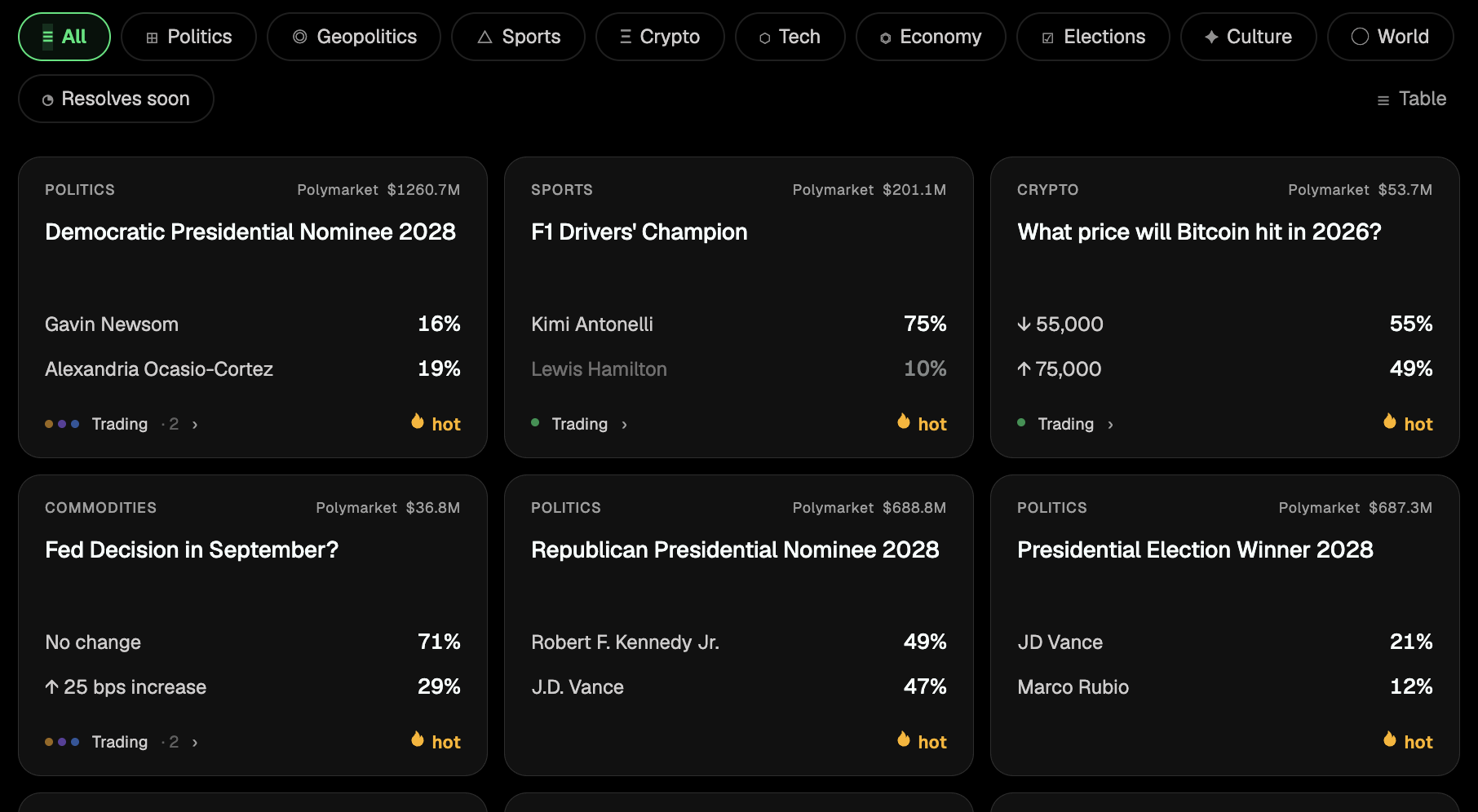
A prediction market trades on what will happen in reality, from elections and rates to sports and launches. Polymarket, Kalshi, and Manifold are the best known. Each market asks a yes-or-no question, and both sides trade as shares priced between 1¢ and 99¢. The price is a probability, so a yes share at 30¢ means the market puts the chance at 30%. When the question resolves, shares on the correct side pay $1 and the rest pay nothing.
Trading them is forecasting. If you think the chance is 50% and the price is 30¢, you buy yes. You do not need to be certain, only closer than the price.
Live data, simulated trading
Every market, price, and resolution comes from Polymarket, the largest prediction market. You trade against real prices in real time, and your positions resolve when the real markets resolve.
Your trading is simulated. The bank is simulated, no order reaches any market, and none of your own money is at risk in an assessment. The data is what is real. Live prices are set by people risking money, so beating them consistently is evidence of skill.
The prop arena model
Prop trading firms run a simple deal. Pass a test on the firm's terms, then trade the firm's capital for a share of the profit. We use that model because we think it can be improved, with rules published in full, risk capped by design, and skill scored directly instead of inferred from profit alone.
The centaur experiment
Humans and AI models fail as solo forecasters in different ways. Early evidence suggests a human working with a model beats either alone. That combination is called a centaur, and this arena exists to measure it.
Every league runs under identical rules, whether the trader is a person, a model, or a person using a model. Trading is adversarial, and someone is on the other side of every trade. We want to learn which form of centaur survives that, with cash and funding on the line.
Pass rates match the real market
Most traders lose. An April 2026 analysis of 2.5 million Polymarket wallets found 84% of traders in the red and roughly 16% in profit. An earlier study of 124 million trades found about 70% losing, with the top 0.04% taking most of the profit. The data is on-chain and public.
Our targets are set against that baseline. Passing here is meant to be about as hard as being profitable on the real market. A test most people pass would prove nothing.